
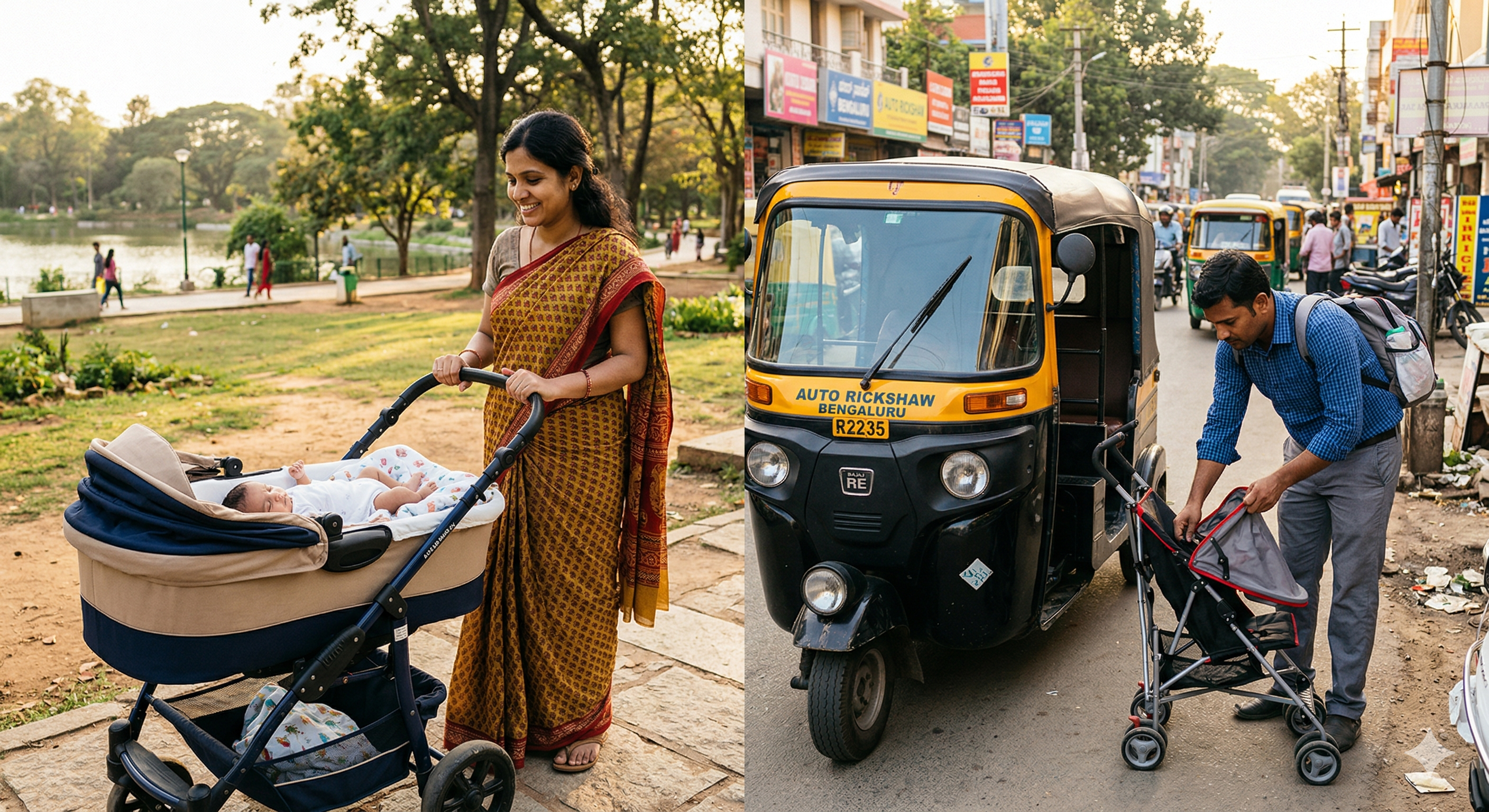
Walk into any baby store in India and you’ll hear ‘pram’ and ‘stroller’ used almost interchangeably. The confusion is understandable — especially for first-time parents trying to make a purchase decision that affects daily life for the next two to four years. This guide cuts through the confusion.
Once you’ve decided which type you need, check our full guide to buying used strollers in India to find the best deals, and our used stroller safety checklist to make sure whatever you buy is safe.
What Is a Pram?
Traditionally, a pram (short for perambulator) is a baby carriage where the infant lies flat in a fully reclined or horizontal position, facing the parent. In modern usage, ‘pram’ refers to wheeled baby transport designed for newborns — typically including a flat-lying bassinet or carrycot suitable from birth.
In India, ‘pram’ and ‘stroller’ are widely used interchangeably by both sellers and parents.
What Is a Stroller?
A stroller is designed for babies who can sit up — typically from around six months. Strollers have an upright or partially reclined seat, are more compact and lightweight than full prams, and are designed for easy folding and manoeuvrability.
According to the Indian Academy of Pediatrics, babies should not be placed in an upright seated position until their neck and back muscles are strong enough to provide adequate support — usually around four to six months of age.
Pram vs Stroller: Key Differences for Indian Parents
- Lying position — Prams support flat-lying for newborns. Strollers are for babies who can sit up (approx. 6 months+).
- Indian road conditions — Full-size prams with larger wheels handle bumpy roads better. Compact strollers are easier in crowded markets and tight spaces.
- Car boot space — Compact strollers fold smaller — matters in Indian hatchbacks and sedans with limited boot space.
- Lift access — In apartments without large lifts, a compact folding stroller is far more practical.
- Climate — Strollers with large canopies offer better sun protection, important in Indian summers.
- Price — Convertible prams: ₹5,000–₹22,000 new. Compact strollers: ₹2,500–₹10,000 new.
Which Should You Buy?
Buy a convertible pram if:
- You’re expecting a newborn — a flat-lying bassinet is safest for the first six months
- You want one product that grows with your child from birth to three or four years
- You plan to have more than one child — a quality convertible pram offers excellent long-term value
- You have good storage space and a large enough vehicle
Buy a lightweight stroller if:
- Your baby is already over six months and sitting up independently
- You live in an apartment and need something compact
- You travel frequently or rely on auto-rickshaws and public transport
- Budget is the primary consideration
Indian-Specific Considerations
Auto-rickshaw and public transport use
If you regularly use auto-rickshaws or metro/bus, a lightweight umbrella stroller that folds in seconds is far more practical than a large pram. Look for strollers weighing under 8 kg with a one-hand fold mechanism.
Monsoon season
A stroller with a full rain cover is worth prioritising in India. Check whether the Wheedle listing includes a rain cover — these can cost ₹500–₹1,500 separately.
Joint family living
In many Indian homes, grandparents and other caregivers will also use the stroller. A simple, intuitive fold mechanism is important so all caregivers can operate it confidently.
Whether you choose a pram or a stroller, browse preloved prams and strollers on Wheedle to find premium brands like Chicco, Joie, and Graco at a fraction of their retail price. You can also view current new stroller prices on Flipkart to compare and understand how much you’d save buying second hand.
| ❓ Frequently Asked Questions |
| Q: At what age can a baby use a stroller instead of a pram? |
| A: Most paediatricians recommend babies use a flat-lying position until at least four to six months, when neck and back muscles are strong enough to support sitting. From six months, most babies can comfortably use a standard upright stroller seat. Always consult your paediatrician if unsure. |
| Q: Can I use a second hand pram from birth for my newborn? |
| A: Yes, if it has been thoroughly inspected and includes a proper flat-lying bassinet or carrycot. Check that the bassinet mattress is firm and flat (no sagging), that it attaches securely to the frame, and that the harness functions correctly. |
| Q: Which is more practical for Indian conditions — a pram or a stroller? |
| A: For most urban Indian families, a convertible pram that starts as a lie-flat bassinet and converts to an upright stroller seat offers the best long-term value. However, for families with compact cars, small apartments, or heavy public transport use, a lightweight compact stroller is often more practical for daily life. |
| Q: What is a travel system and is it worth buying second hand? |
| A: A travel system combines a pram chassis with a compatible infant car seat. The pram and bassinet components are safe to buy second hand. However, always buy the infant car seat new, or only from someone whose full accident history you can personally verify. |
| Q: What is the average price for a second hand pram on Wheedle India? |
| A: Budget Indian brands (Mee Mee, LuvLap): ₹600–₹2,500. Mid-range (Joie, Graco): ₹2,000–₹6,000. Premium (Chicco): ₹3,000–₹9,000. Prices depend on age, condition, and accessories included. |
Leave a Reply